A motor does not just stop the moment you cut its power. It fights back. Every spinning motor has inertia, and when a VFD tells it to slow down fast, that motor turns into a generator for a few seconds, pumping energy straight back into the drive. If that energy has nowhere to go, the drive trips out on overvoltage, and your production line stalls for reasons nobody upstairs wants to hear about. This is exactly where braking resistors, and specifically aluminum-housed metal-clad braking resistors, earn their keep in real industrial setups.
This blog walks through when you actually need one, how to spot the warning signs before a fault takes your line down and what to look for when you’re picking a supplier. No fluff, just the stuff that matters on the shop floor.
What Happens Inside a VFD During Deceleration
A VFD controls motor speed by adjusting frequency and voltage. Simple enough. But physics doesn’t care about your control settings. When you command a fast stop, or when a load like a crane, elevator, or centrifuge tries to overrun the motor, the motor’s rotor keeps spinning faster than the commanded speed for a brief window. That mismatch generates regenerative energy.
This energy flows back through the motor windings into the drive’s DC bus. The DC bus voltage climbs. If it climbs past the drive’s safe threshold, the VFD faults out to protect itself, usually flashing an overvoltage error. Anyone who’s worked around industrial drives has seen that fault code more times than they’d like.
A braking resistor gives that regenerative energy a place to burn off as heat instead of backing up into the bus. It’s not glamorous engineering; honestly, it’s one of the simplest fixes in the whole drive system, but it works reliably when sized right.
Signs You Actually Need a Braking Resistor
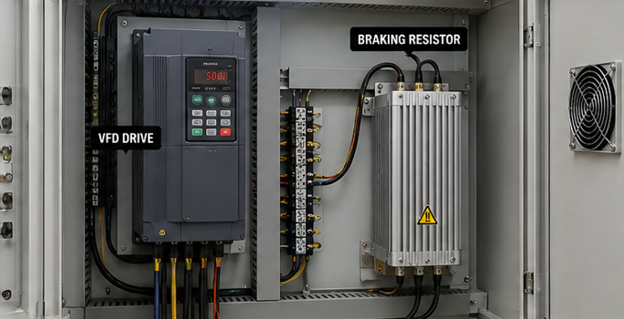
Not every VFD application needs one. A simple pump running at constant speed with a gentle ramp down rarely generates enough regenerative energy to matter. But certain applications almost always need braking resistors, and ignoring that need shows up fast as nuisance trips.
- High inertia loads like centrifuges, large fans, and flywheels that keep spinning after the motor command drops
- Overhauling loads such as cranes, hoists, elevators, and conveyors on a downward incline, where gravity actively drives the motor
- Fast stop or fast reverse cycles, common in packaging lines, printing presses, and machine tools where cycle time is everything
- Frequent start-stop operation, where the drive is constantly absorbing regenerative energy in short bursts
If your maintenance logs show recurring overvoltage faults during deceleration, that’s usually the first practical clue. I’ve seen plants chase phantom electrical gremlins for weeks when the actual issue was a missing or undersized braking resistor.
Why Aluminum-Housed Metal-Clad Braking Resistors Specifically
Regular resistors can handle regenerative braking in theory, but industrial environments are rarely kind. Dust, vibration, moisture, and cramped panel space all take a toll. Aluminum-housed metal-clad braking resistors were basically built for this exact headache.
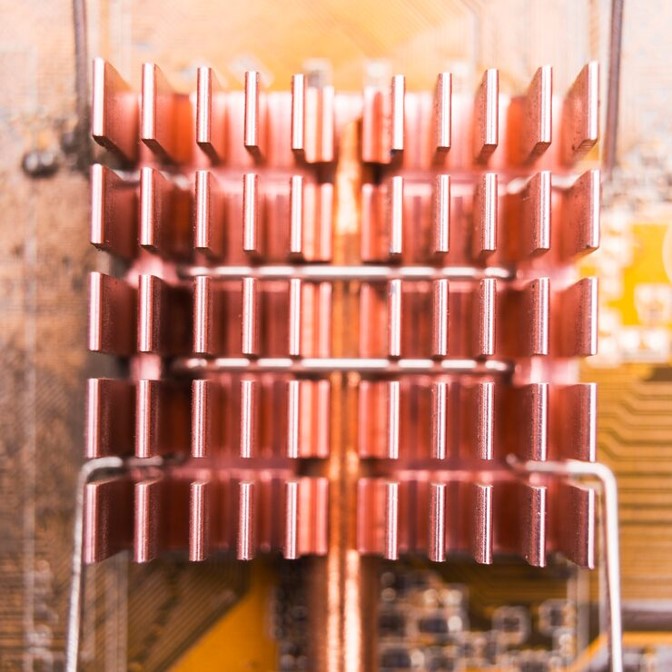
The metal-clad construction wraps the resistive element in a rugged aluminum enclosure that dissipates heat efficiently and protects the internal winding from mechanical damage. That aluminum housing also acts as a natural heatsink, letting the resistor handle higher power density without needing a massive footprint inside the panel. For applications where panel space is tight, and honestly, it almost always is, that matters more than people expect walking into a project.
There’s also the safety angle. A metal enclosure contains heat and reduces the risk of an exposed hot element causing burns or igniting nearby debris, which is a real concern in dusty manufacturing environments like textile mills, cement plants, or steel processing units.
Sizing a Braking Resistor Properly
Getting the resistor value and power rating right is where a lot of projects go sideways. Too low a resistance and the braking current spikes beyond what the drive’s brake transistor can handle. Too high and braking becomes sluggish, meaning the DC bus voltage still creeps up during hard stops.
The calculation generally comes down to three things:
- The kinetic energy of the load that needs to be dissipated
- The duty cycle, meaning how often and how long braking events occur
- The peak braking power required for the fastest deceleration ramp
Most reputable power resistor manufacturer teams will ask for your motor rating, drive model, load inertia, and deceleration time before recommending a resistor value. If a supplier skips these questions and just hands you a generic part number, that’s usually a red flag worth noticing.
A Quick Real-World Scenario
A packaging company running high-speed conveyors switched from long, gentle stops to quick reversals to cut cycle time. Their VFDs started tripping on overvoltage almost immediately after the change. The drives themselves were fine, nothing wrong there. The regenerative energy from the sudden reversals simply had nowhere to go fast enough.
Adding correctly sized aluminum-housed braking resistors solved it within a day. No firmware changes, no drive replacements, just the right resistor doing the job it was designed for. It’s a small fix, but it’s the kind of thing that gets overlooked until production numbers start slipping.
Choosing a Reliable Manufacturer
Not all resistors are built equal, even when the specs on paper look similar. A high-power aluminum resistor manufacturer with real manufacturing depth will typically offer:
- Custom resistance and wattage values instead of only standard catalog sizes
- Proper thermal testing data, not just marketing claims
- Compliance with relevant safety and quality standards
- Responsive technical support for sizing and application queries
Cutting corners on resistor quality tends to show up later as premature failure, inconsistent braking performance, or thermal issues inside the panel. It’s rarely worth the small upfront savings.
Conclusion
Braking resistors are not an optional add-on for high inertia or overhauling loads; they’re a practical necessity that keeps VFD systems stable and downtime low. Knowing when to add one, understanding why aluminum-housed metal-clad construction holds up better in tough industrial settings, and sizing it correctly based on real load data makes the difference between a smooth-running line and a plant full of nuisance trips.
For teams looking for dependable braking resistor solutions built for real industrial demands, Onics power resistor brings decades of manufacturing experience to the table.
FAQs
- Do all VFD systems need a braking resistor?
No. Applications with constant speed operation and light loads rarely need one. Braking resistors become necessary mainly with high inertia loads, overhauling loads, or frequent fast stop cycles.
- What happens if a braking resistor is undersized?
An undersized resistor can overheat, trip on thermal protection, or fail prematurely, and it may not dissipate regenerative energy fast enough to prevent overvoltage faults.
- Why choose aluminum-housed metal-clad braking resistors over standard wire-wound types?
The metal-clad aluminum construction offers better heat dissipation, mechanical protection, and compact sizing, making it more suitable for demanding industrial panels with limited space.
- How do I know the right power rating for my application?
It depends on load inertia, deceleration time, and duty cycle. Sharing your motor and drive details with an experienced power resistor manufacturer gets you an accurate recommendation instead of a guess.