Aluminium Housed Chassis Mounted Wire Wound Resistors
Description
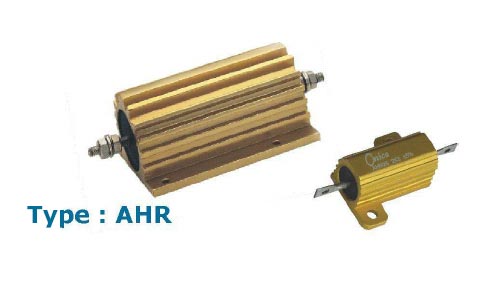
We are one of the leading manufacturer of Aluminium housed chassis mounted wire wound resistors from India. Our aluminium housed resistors exhibit high performance and a long service life and are extensively used across industry. These are RoHS complaint and comply to international quality & safety standards.
Construction:
Aluminium housed Resistor are wound with NickelCopper or Nickel Chromium wire for obtaining required resistance on a ceramic core fitted with end caps. The winded assembly is then encapsulated in a anodised Heat sink using high temperature moulding compound.
| Power Rating | 5 Watts to 250 Watts |
|---|---|
| Terminations | Lugs for 5 - 50W , Screws for 100 - 250W |
| Temp Coeff | ± 50 PPM to 200 PPM |
| Tolerance | ± 10%, Closer tolerances available. |
| Dielectric Voltage | 1000 VAC for 5W & 10W, 1500 VAC for 25 W & 200W 2000 VAC for 250 W |
| Operating Temp | -55°C to 250°C |
| Deratings | Deratings required for reduced chassis mounted area and for high ambient temperatures. Derate to zero Power Linearly at 250°C ambient. Derating necessary for unmounted resistors at ambient temperatures of 25°C, 5W & 10W - 40%, 25W-50% 50W & above 60%. |
- Low Cost, Light weight & Compact.
- Non-inductive Type available.
- Custom Values available.
These Resistors are applied where high wattage dissipation is required in a small space. The metal heat sink ensures good heat dispersal & allows a low hot-spot temperature. Major appliactions include Induction furnace, Medical equipments, Humidity Chambers etc.
DIMENSIONS & RANGE:
| DimensionsinM . M .M | Dimensions M.M.for Aluminium Heatsink | Resistance Range | ||||||||||||||||||
|---|---|---|---|---|---|---|---|---|---|---|---|---|---|---|---|---|---|---|---|---|
| Watts | A ±1.0 | B ± 0.25 | C Max 4.0 | D ± 0.25 | E ± 1.60 | F ± 1.00 | G ± 1.00 | H ± 0.80 | l ± 0.25 | J ± 0.80 | K ± 0.13 | L Max | M ± 1.60 | N ± 0.50 | P ± Min | Q ± 0.13 | R | S | T | |
| 5 | 28.6 | 12.5 | 2.00 | 11.3 | 15.3 | 6.80 | 8.50 | 12.5 | - | 16.4 | 2.40 | 8.20 | 3.40 | 1.70 | 1.60 | 1.30 | 100 | 100 | 2.0 | 0.1W-500 |
| 10 | 34.9 | 15.9 | 2.40 | 14.3 | 19.1 | 7.90 | 10.70 | 15.9 | - | 20.4 | 2.40 | 9.90 | 4.20 | 1.90 | 2.00 | 2.00 | 100 | 100 | 2.0 | 0.1W-1k |
| 25 | 50.0 | 20.0 | 4.40 | 18.3 | 27.0 | 11.2 | 14.0 | 20.0 | - | 27.5 | 3.18 | 14.0 | 5.90 | 1.90 | 2.00 | 2.00 | 150 | 150 | 1.5 | 0.1W-5k |
| 50 | 71.0 | 21.4 | 5.0 | 39.8 | 50.0 | 11.2 | 16.0 | 21.4 | - | 29.0 | 3.18 | 15.5 | 7.90 | 2.25 | 2.00 | 2.00 | 150 | 150 | 3.0 | 0.1W-10k |
| 100 | 95.0 | 37.0 | 15.0 | 35.0 | 65.0 | 15.0 | 26.0 | 37.0 | - | 47.0 | 5.0 | 26.0 | 11.0 | 3.50 | 4.00 | - | 150 | 200 | 3.0 | 0.1W-20k |
| 150/200 | 139 | 57.0 | 9.50 | 70.0 | 89.0 | 25.0 | 46.0 | 57.0 | - | 73.0 | 5.0 | 45.0 | 20.0 | 5.0 | 5.00 | - | 150 | 300 | 3.0 | 0.1W-35k |
| 250/300 | 178 | 63.5 | 8.0 | 98.4 | 115 | 32.0 | 54.0 | 63.5 | 76.0 | 76.0 | 5.0 | 56.0 | 25.0 | 5.0 | 6.00 | - | 300 | 300 | 3.0 | 0.1W-50k |
R = Length, S = Width, T = Thickness
value & wattages lower & higher than specified available. Non - inductive type available.
Frequently Asked Questions
Aluminium housed resistors are electrical resistors enclosed in an aluminium casing that helps dissipate heat. They are commonly used in industrial equipment, motor control systems, power supplies, and electronic circuits that require reliable power resistance.
Aluminium housed resistors offer effective heat dissipation, a compact design, and convenient mounting options. Their metal housing helps transfer heat away from the resistive element, supporting stable operation when the resistor is used within its specified ratings.
Chassis mounted aluminium housed resistors are used in motor drives, braking circuits, power conversion systems, industrial automation, and load control applications. The suitable resistor depends on the circuit requirements, power rating, and operating conditions.
Consider the required resistance value, power rating, operating voltage, tolerance, mounting arrangement, and ambient temperature. Proper heat sinking and ventilation are also important to help the resistor operate safely within its rated limits.
To request aluminium housed resistors, provide your required resistance value, power rating, quantity, and application details. Contact the PowerResistor.in team to discuss suitable options and confirm product specifications and availability.